
How to Get Court Records
Your first stop is Indiana MyCase, the public face of Odyssey. Pick Gibson County. Then search by case number, citation number, party name, business name, or attorney. Each result can show the court, the case type, its status, public parties, charges where they apply, and the running event chronology. Treat it as a helpful index. The state itself warns that the display is not the official court record. And a hit does not mean every document is open online.
For the official file, go to the Gibson County Clerk, actually: Gibson County Clerk. You can ask at the counter. You can call, mail a letter, or send a reasonably specific message to the published email. Give the court, the case number if you know it, the case type, the date range, and the exact event or paper you need. Say whether you want a plain copy or a certified one.
- Search MyCase and confirm the Gibson court and case number.
- Read events to identify the filing or order by date.
- Check the public-document table for that case type.
- Call, write, email, or visit the Clerk if no download appears.
- Ask for current fees and delivery options before paying.
Gibson County Record Request Details
Help the Clerk zero in on the right Gibson County court record by being specific. Name the court, Gibson Circuit or Superior. Give the full cause number if you have it. Point to the filing, order, exhibit, or event by its date. Say plainly what you want: to inspect the record, get a plain copy, or get a certified copy.
No cause number? Offer a tight party name, the case type, and a date range worth searching. Older converted files sometimes carry a legacy cross-reference. So include both numbers when a paper notice and MyCase disagree. For a transcript, skip the Clerk's copy counter. Ask the court reporter who covered the proceeding.
Three Gibson Court Record Products
Gibson County offers three distinct record products, and each answers a different question. The docket view is the public summary that helps you spot an event; a plain copy reproduces one specific non-confidential document; and certification adds the Clerk's official attestation to that copy.
| Product | Source | Use |
|---|---|---|
| Case summary | MyCase | Public identity, status, parties, and events; not the official record. |
| Plain copy | Gibson Clerk | A copy of a named public filing or order. |
| Certified copy | Gibson Clerk | Official certification; a browser printout cannot be self-certified. |
Some papers live outside the court docket altogether. Divorce decrees, estate papers, and wills run through the county-clerk route laid out in Indiana's request guidance. A transcript is the outlier, since the court reporter for the proceeding handles that request rather than the Clerk.
Types of Court Records
Gibson County dockets cover a wide stretch of legal ground: criminal, civil, family, probate, small claims, traffic, protection-order, juvenile, adoption, guardianship, and mental-health cases. A local allocation plan sorts these groups between Circuit Court, Superior Court, and, for some work, the magistrate. That sorting decides where a file sits. But one elected Gibson County Clerk serves all the county courts.
Knowing the vocabulary helps you read what you find. An order is a ruling the court has filed. A pleading is a paper filed by a party. An exhibit is evidence received or kept for a case. The court reporter prepares any transcript. The docket itself is the dated index that ties these pieces together. One caution applies: an event can show on the docket. The paper behind it may still take a request at the counter.
- Plain copy
- A reproduction without certification.
- Certified copy
- A copy attested by the record custodian.
- Transcript
- The court reporter's written hearing record.
- Converted event
- An older entry imported into Odyssey, not necessarily a new act on that date.
Gibson Court Records and E-Filing
Attorneys in Gibson County file court papers through Indiana's statewide e-filing program. The program handles filings only. It does not sell copies of court records to the public. So ordering an official copy is a different errand entirely. People without attorneys have options too, which state rules lay out. The Gibson Clerk can point the way.
The state's official e-filing page spells out how the submission route works.
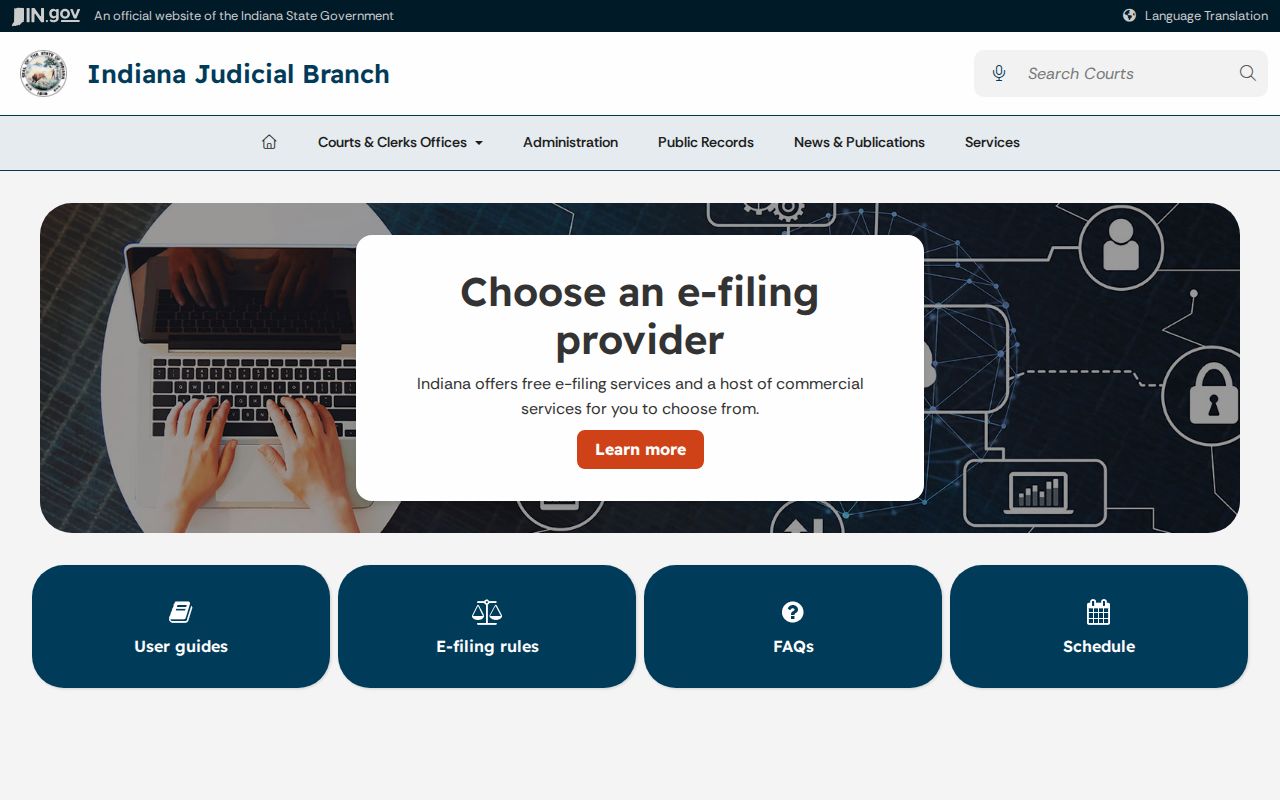
E-filing tells you where papers go in. For reading a Gibson court docket, MyCase is still the public lookup, and the Gibson Clerk still issues the official copies that carry weight.
What a Court Record Contains
Start with the court and caption. From there, a Gibson County court record gives you the case type, its status, and the newest events at a glance. Every local case number opens with county code 26. 26C01 marks a Circuit case. 26D01 marks Superior. The year, month, case-type code, and sequence number follow. Those pieces let the Clerk tell apart parties who share a name.
| Identity | Case number, caption, court, type, file date, and status. |
|---|---|
| Parties | Public names and roles, with restricted data withheld. |
| Events | Filings, orders, settings, clerk acts, comments, and converted entries. |
| Documents | Links when allowed; an event can lack a downloadable file. |
| Finance | Some data may appear, but the Clerk confirms current balances. |
A role label is not a judgment. Treat "Decided" as a system status rather than a full account of the order, since collection work and other follow-up may come later. When official meaning matters, read the final order and ask the Clerk.
Gibson County Paper Record Route
Not every docket entry comes with a download. Some Gibson County court records live only in paper files. Others sit at the clerk's counter rather than online. Indiana's document table draws a line between remote access and in-person access. That line matters. Certain non-confidential material has a wider counter route than MyCase offers. So a missing scan is not proof of a sealed case.
The Gibson County Clerk takes focused questions by phone, email, mail, and in person at the counter. Ask whether the paper file exists, whether redaction is pending, whether the case type is restricted, or whether another officer keeps it. One absent link tells you very little on its own. Treat the docket as a map, not the whole territory. Let the clerk fill the gaps.
When Gibson Court Records Are Missing
A missing download never proves a case is sealed. Indiana can list a docket entry yet limit remote access to the paper copy. Older files may simply have never been scanned. Or a filing could await redaction, fall under a case-type limit, or carry information excluded by Access Rule 5. In many misdemeanor and felony files, the sentencing order appears online while other public papers must be requested in person. Read each docket entry with that gap in mind.
Best next step: Give the Clerk the case number, event date, and document name. Ask if it is public, counter-only, still on paper, or restricted by rule or order.
Start with a simpler question for an old exhibit: does it still exist? Gibson's local rules set retention periods. They vary by category and by how the case ended. Civil exhibits may be destroyed months after the decision. Criminal evidence can be kept far longer. And DNA falls outside ordinary disposal entirely, so it stays put.
Certified Copies and Fees
No current certified-copy price, exemplification charge, or per-page fee is published for Gibson County. Ask the Clerk for a quote once you know the exact court record you need. Prices from another Indiana county will not apply here. For context on Indiana trial court charges, the Trial Court Fee Manual lays out the framework. The Clerk still sets the final cost. The Clerk also decides the delivery method for your copy order.
| Item | Amount | Action |
|---|---|---|
| Plain copy | Not published | Ask for current page and delivery cost. |
| Certified copy | Not published | Request certification and a quote. |
| Transcript | Local rule lists up to $7.50 per page and $35 minimum in stated circumstances | Confirm with the court reporter. |
Gibson County Certification Choice
A plain copy works fine for everyday reference. A certified copy adds the Clerk’s official certification. That matters when another court or agency needs proof straight from the case file. Name the exact document in your request rather than asking vaguely for the “full record.”
Gibson County posts no general document-order form and no local copy-price schedule. Before you mail any funds, check with the Clerk. Confirm the certification charge, accepted payment, delivery options, and handling time there. Keep filing fees separate in your mind from reproduction costs. They are two different things.
Gibson Court Transcripts and Bulk Data
Transcript requests go to the reporter who covered the hearing or trial. Give the court, case number, hearing date, and the portion you need. MyCase can help you find the date. It does not supply the transcript itself. Check the local rule before you order. Rates, binding, and supply charges are spelled out there.
Compiled data runs through a separate Office of Court Services application and fee structure. Repeated MyCase searching is no substitute. Its terms bar data mining. A single Gibson County court record stays with the Clerk. A true bulk request belongs in the state process.
Public Access and Sealed Records
Access Rule 4 opens the courthouse doors by default. Another rule, law, or order can carve material out. Rule 5 then shields juvenile, adoption, mental-health, personal identifier, victim, medical, financial, expungement, and supervision information. Even a public case can hold restricted fields.
Juvenile, mental-health, and adoption matters sit outside the ordinary public online and counter records under the document table. Protection orders and granted expungements follow their own treatment. Sealing means more than a missing link; statute and court order govern it.
Key Rules:
Access Rule 4 sets the public-access framework.
Access Rule 5 lists confidential court information.
Indiana Code 5-14-3-3 supports reasonably particular requests, subject to court restrictions.
When access runs into a wall, ask the Clerk which rule applies and what route is open to you. That beats guessing the case is sealed.
Gibson Forms Are Not Copy Orders
Gibson County publishes packets for divorce, small claims, and protection orders. Those forms start or manage a case. They do not order a decree, judgment, or certified copy from an existing file. Divorce packets gather caption, party, service, family, declaration, and signature details. Small-claims forms cover parties, the claim, service, verification, and a corporate-resolution branch. Protection-order materials split public content from confidential content.
Use the Gibson forms route to prepare a filing. Use the Clerk request route to pull an existing court record. Confidential form fields should never go into a broad public request. Statewide forms live in the Indiana forms library.